


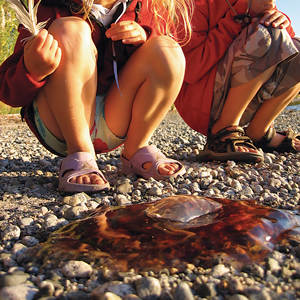
Jellyfish – those brainless, heartless and slimy creatures that compel some of us to make a beeline for the beach chair and others to find the perfect stick for poking, are crucial to medical scientists looking for ways to prevent hearing loss. Interestingly enough, the common jellyfish can’t hear, think or see, but it is a valuable tool in medical research.
“The jellyfish we use in our studies in the lab are much smaller than the ones you might encounter in the waves or on the beach,” says Barry Strasnick, MD, professor and chair of otology/neurotology at Eastern Virginia Medical School. “Fortunately, I’ve never been stung!”
Dr. Strasnick is a leading researcher examining the effects of gentamicin, an aminoglycoside antibiotic used to treat many types of bacterial infections, on human hearing. The MEDARVA Foundation, formerly Richmond Eye and Ear Foundation, is funding the Research with the goal of preventing hearing loss in patients who might benefit greatly from these medications.
“Jellyfish are a perfect subject for study,” Dr. Strasnick notes. “They are easily cultured in test tubes, they have large cells, and they don’t feel pain – although they can cause it sometimes.”
According to Strasnick, jellyfish possess hair cells, which like hair cells present in the anatomy of the human ear, can be damaged and ultimately destroyed by antibiotics such as gentamicin. For this reason, gentamicin is labeled ototoxic, or poisonous, to the ear.
“Since we know that the hair cells in the human ear are similar in structure to jellyfish cells and react to gentamicin in potentially similar ways, we can see how jellyfish hair cells react to different levels of drug administration without risking the hearing of human subjects,” Dr. Strasnick continues.
Hair cells like these are found in many animals. They are extremely sensitive to changes in position and environment.Their function in the human ear is to help maintain balance by responding to head and body movements with signals to the brain that result in instantaneous corrections.
Antibiotic use Presents a challenging opportunity for healthcare providers.
Anyone who has listened to a doctor explain her reluctance to prescribe antibiotics without due indication knows as bacteria become more resistant to certain kinds of antibiotics, finding ways to reduce side effects of effective antibiotics becomes more and more important. The goal is to balance infection control with possible drug complications and negative side effects.
That’s where the jellyfish comes in.
Dr. Strasnick and his colleagues grow jellyfish and place them in seawater with various concentrations of gentamicin for Varying lengths of time. The movements of the jellyfish are measured and the cells are stained and examined under the microscope. These experiments have shown a demonstrated loss of hair cells within minutes; the more hair cell loss, the more the jellyfish movements are reduced. This is what’s known as a dosedependant association, meaning as drug exposure increases, so does the damage to the hair cell.
This important research will help scientists find ways to protect the hair cells in the ears of patients requiring gentamicin and its antibiotic relatives and in the long run preserve their hearing.
A Closer Look at Jelly Fish
by Sarah Lockwood
While they’re a force for good in the lab and even a delicacy in some Asian countries, to most of us, jellyfish are a pain-in-the-youknow- what. Adult jellyfish are called medusa, and might as well be the snake-haired monster herself.
There are hundreds of species known as jellyfish. In our area, it’s the moon jellies – the most common species – to look out for.You wouldn’t want to meet up with their freshwater brothers, sea nettles, in the Chesapeake Bay either. The tentacles of the jellyfish, hanging from its mushroom cap blob of goo, are used for food gathering and defense. Jellyfish have no brain, but they sting defensively , and inject poison into everything they touch.
Unfortunately for us, jellies enjoy the summertime as well, making their largest, most active appearances just as we’re loading up on sand buckets and sunscreen. So how do you avoid the painful effects of medusa?The obvious answer is not to touch one, but it’s not that simple.
Jellyfish swarm in the currents and wind.If you see one, it will probably have friends, who may be difficult to see in the darker mid-Atlantic waters. Jellyfish tentacles can be very long, so avoiding the mushroom cap of doom is not enough. It’s best to stay out of any area where a single jellyfish has been spotted. Dead and sand-covered jellies can still sting, so watch for those on the beach as well.
Whether the kids touch an intriguing blob on the beach before you can warn them or a wave sweeps their tentacles around your legs, jellyfish stings will happen. While painful, jelly stings in our region are not fatal, except in rare cases of severe allergies. If a reaction including difficulty breathing, mouth swelling, or fainting should occur, get emergency help.
Otherwise, jelly sting first aid should begin by prompt removal of any tentacles. Use gloves or tweezers and move slowly. Don’t scrape tentacles off. Rinse the area with fresh or salt water and use an ice compress to decrease pain. You may need to use 1 percent hydrocortisone cream to alleviate itching.
While jellies can be a pain, let’s just be glad that the lion’s mane jellyfish, with its 90-foot tentacles, doesn’t frequent our favorite waters.
Jellyfish have propelled themselves through every ocean on the planet since before dinosaurs. And now, 500 million years later, the stinging nuisance is starting to redeem itself.Who knows? If studying this beautifully dangerous creature can help prevent hearing loss, imagine the other benefits the mysterious medusa might hold for humankind.