


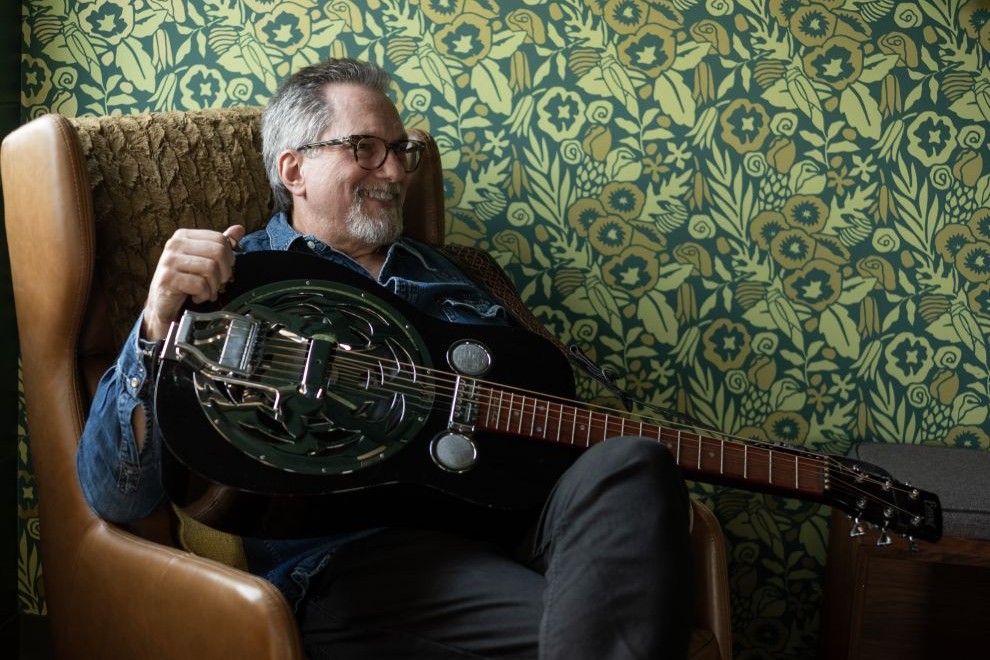
Jerry Douglas would like to bottle the warm, fuzzy, upbeat feeling he gets every time he plays music on stage.
“It’s such an endorphin release,” says Douglas who will be performing with this band on November 3 at Tin Pan. “It’s the only time a musician feels complete, and it’s the happiest time for us.”
A 16-time Grammy winner and three time CMA Musician of the Year, Douglas is a master of the dobro (resonator guitar). In 2004, he was recognized by the National Endowment for the Arts with an American Heritage Fellowship, and he served as the Country Music Hall of Fame and Museum’s “Artist In Residence” in 2008.
Unlike some who would keep their awards in clear view, Douglas doesn’t like looking at his awards. “I do have a room for all that stuff. But, I don’t want to be reminded. I want to keep thinking about what’s coming and not what has already happened,” he says, adding, “Awards are nice, but that is not why we do this.”
Discovering the Sound of the Dobro

Douglas was around the age of 10 when he got interested in the dobro. “My father had a bluegrass band, and I got to see them practice. I also loved Flatt and Scruggs (an American bluegrass duo),” he says, noting that it was the sound of the dobro that really “turned me on.”
Douglas figured out how to tune and play the instrument from listening to records and from members of his father’s band. “It just seemed to come to me,” he says. “It was easy. I fell in love with the instrument and that is what got me hooked.”
In addition to touring with his own band, Douglas is a member of several ensembles, including Alison Krauss & Union Station and The Country Gentlemen. He has recorded more than 1,500 albums with artists such as Little Big Town, Garth Brooks, Paul Simon, and Elvis Costello.
“I was just in Richmond with Alison Krauss & Union Station. We played at the Allianz Amphitheater at Riverfront,” he says, adding he’s been performing with the group since 1998. “It was really wonderful.”
Blending In
Douglas, who has produced albums for other artists, has played in practically every genre of music, from jazz and bluegrass to classical and hip hop. He enjoys blending in, being a chameleon, when’s he’s working with another artist.
“I adapt to my surroundings,” he says.
Producing is a different mindset for him. When he is playing on a session, he really focuses on his music and fitting into the track. “When you are producing, you have the big picture. It’s a lot like painting or being the director of a movie. You are casting for the song and getting people to fit the song,” he says.
The job of a producer is to get the best out of the band and the best performance for the song and “put that together,” he adds. “You want to also preserve the artist’s personality. You can get to know somebody really well by listening to their songs.”
Working as a producer is a benefit to Douglas as well. “I think that makes me a better musician. It serves me well.”
When he’s not producing, he’s on the road. On average Douglas plays 120 dates a year. “This year I probably did more because we did the United Kingdom and Europe,” he says.
He’s glad to wind down the year at Tin Pan. “I have been playing to about 8,000 people a night, and this is a small venue,” he says. “I’ll be able to look at who I am playing for. I’m looking forward to it.”