

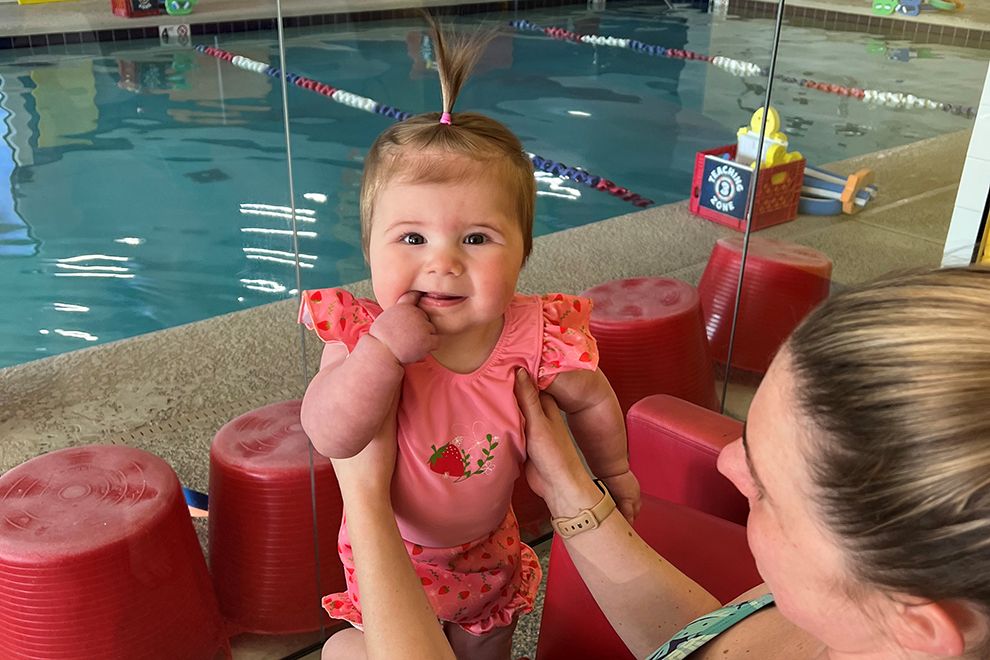
When I registered my 6-month-old daughter Hallie for her first lesson at a local swim school, I didn’t think a mommy-and-me swim class could teach me, a former Division I college swimmer and swim instructor, anything new. But once I entered the damp locker room with my crying baby and realized I had to wrangle her into a bathing suit, my confidence sank faster than a diving ring. By the end of the first lesson, I realized these sessions would be a learning experience for both Hallie and me.
If you’re a first-time parent considering swim lessons for your child, don’t let this anecdote deter you. Instead, here are a few tips and tricks that I learned during our first swim lessons and my time as a swim instructor to help give you peace of mind and approach your little one’s first dip in the pool like a pro.
1. Just because your baby likes the bath doesn’t mean they’ll automatically enjoy swim lessons.
Hallie loves bathtime, so I figured she’d enjoy the pool too. It’s just a big bathtub, right? Wrong. Our first swim lesson was on a busy Saturday when the pool was packed with kids of all ages, and my husband and I both commented afterwards that even we felt overwhelmed by it all. It’s no wonder Hallie took one look around this new environment and started crying.
Don’t blame yourself — or your baby — if there are waterworks during the first several lessons. If your child is anything like Hallie and struggles with the chaotic weekend atmosphere, consider signing up for lessons at a time when the pool is less crowded. I ended up rescheduling our lessons for Mondays, which are generally much quieter. It was a total gamechanger and made lessons much more manageable.
2. Wait until you get to the pool to put the swim diaper on.
I thought I was thinking ahead and saving time when I put Hallie’s swim diaper on at home before our first lesson. But the moment I heard rumbles from her car seat on the way to the pool, I knew I was wrong. A lot of disposable swim diapers go on like underwear and don’t have adjustable straps on the side. This can make a messy situation a whole lot messier.
I’m embarrassed to admit this, but it wasn’t until after the fact that I discovered swim diapers are not actually meant to contain liquids. That means pee passes right through the diaper when outside the pool. It turns out putting the swim diaper on at home was the wrong move since she would have soaked her clothes if she peed on the way to the pool. PSA to all parents of swimmers who are not yet potty-trained: buffer in a few extra minutes to change your child into their swim diaper at the pool.
3. Pool temperature matters.
I swim for exercise once a week in a lap pool at our local gym. My swim friends and even fellow lap swimmers have asked why I don’t just bring Hallie to that pool and teach her to swim myself. I have several reasons, a big one being that babies are most comfortable in warm pool water up to 90 degrees, and lap pools are generally kept around 80 degrees, if not lower, according to U.S. Masters Swimming.
If you’re tempted to think your baby or young child is “being a baby” about cold water, think again. Due to the ratio of body surface to overall weight, a small child loses body heat much faster than an adult. So, while I wouldn’t want to swim laps in a 90-degree pool, this temperature is perfect for babies.
Sometimes my former competitive swim friends scoff when I tell them I’m taking Hallie to a chain swim school, but I stand by my choice since the pool is guaranteed to be warm. If you want to increase your chances of having a positive swim lesson experience for your baby, I recommend selecting a warm water option.
4. Have a game plan in case your baby cries.
Going into our first lesson, I told my husband we needed a game plan if Hallie became so upset that we needed to remove her from the pool. We’d had enough freakouts at home and in public at this point that I was anticipating the worst.
Since I would be in the water with Hallie, I told my husband that I’d stay in the pool if this occurred, and he would sit with her on the side and watch. Sure, maybe all the other parents would have judged us, but I was willing to do the mommy-and-me lesson sans baby. Why? Because I wanted Hallie to see me and the other participants having fun and staying safe in the water to help her understand that she would be okay too. This was a rule I adopted when I was a swim instructor, and I promise it works.
5. Keep going back!
I’d be lying if I told you I wasn’t dreading the second swim lesson. At the end of our first session, the instructor sweetly told me that, in her experience, there were even more tears during the second lesson. She said to be prepared for this, but not to get discouraged — usually the tears subsided after a few weeks in the pool.
For the second lesson I would be solo-parenting, and I was so worried about how it would go that I lost sleep the night before. I imagined all kinds of awful scenarios, like Hallie shutting down the pool with a poopy swim diaper or breaking a window with her shrill cries. But guess what? We survived. Sure, there were some tears, but we made it through the lesson and lived to tell the tale.
Hallie didn’t even cry during the third lesson, and by the fourth she was smiling and having fun with the other babies. It’s been smooth sailing ever since, and now she beams the moment we walk through the doors of the swim school. I’m convinced this time in the pool has become her favorite 30 minutes of the week.
If you’re tempted to throw in the literal and figurative towel after your first swim lesson, remember that this time in the water teaches your child lifelong safety skills. Drowning is a leading cause of death for children in the United States, according to the American Red Cross, so it’s vital that your child learns to be safe in and around the water. Not to mention, swim lessons equip your child with the skills to participate in a lifelong sport. Whether that means simply playing sharks and minnows at the summer pool or one day swimming laps for exercise, the ability to swim will serve them well beyond childhood.