Richmonder Miriam Rubel Davidow grew up in the shadow of the Holocaust. Her late mother, Ruth Bonyhadi Rubel, was a Holocaust survivor who came to America in 1946.
“She wouldn’t share specifics about the Holocaust. She kept it pretty close, but we knew she had nightmares and had experienced a lot,” says Davidow, noting her mom was 12 when she was confined to the ghetto with her mother.
To appease the Germans, Ruth learned how to sew while she was in the ghetto and “became an amazing seamstress,” Davidow says. “She also learned English in the ghetto because there were a lot of educators there.”
She talked about her feelings very little but told Davidow that she was deprived of her teen years.
“She was pretty much on her own, sometimes even in the worst of circumstances,” says Davidow.
In the ghetto, Ruth learned that you have to get on with your life, that life goes on. “She was angry,” Davidow says, noting her mother’s mom died two weeks after liberation. “When she came to this country, a lot of people told her she had to get on with her life but how do you do that when you have no faith in the world?”
Davidow watched her mother prepare to die in 2001 and she realized that her mom wasn’t afraid.
“I guess it’s tough to put yourself in anyone else’s situation,” she says, noting that there was always a mystery about those days in the ghetto. “I saw how much she loved and how she put that love into her children and grandchildren. My granddaughter’s middle name is my mom’s name. It makes her feel connected to my mom.”
Davidow is just one of the Holocaust family members who are sharing their stories by participating in the Virginia Holocaust Museum’s Legacy Lives On: Intergenerational Portrait Project – a statewide initiative to photograph Holocaust survivors and/or their family members in order to explore how survivor experiences continue to shape families today.
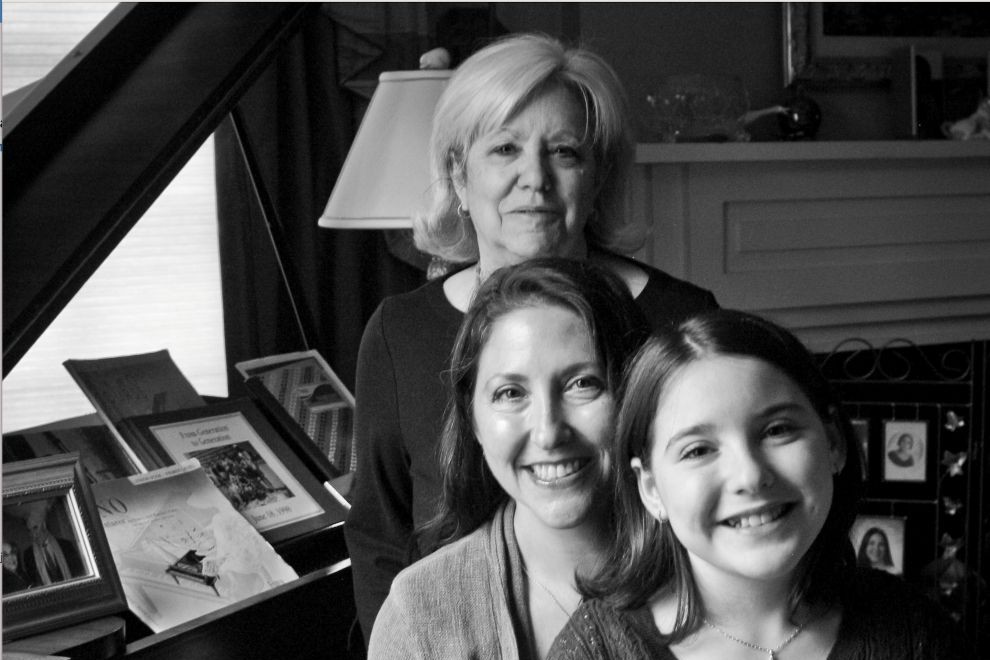
Davidow’s portrait in the exhibit includes her daughter, Alisa Davidow Shapiro, and granddaughter, Lila Ruth Shapiro.
Samuel Asher, president and executive director of the museum, got the idea for the project after traveling to France last year where he saw an intergenerational project documenting the stories of French Holocaust survivors and their families inside a historic church in Arles, France.
“I thought to myself ‘this is so fantastic. I have to bring back to Richmond,’” Asher says. “I encourage anyone in Virginia who is Holocaust survivor — along with their family members — to participate in this photographic initiative honoring legacy, identity and remembrance. Get in touch with the Holocaust Museum.”
The contemporary black-and-white photos that will be featured in the exhibition will be taken by award-winning photographer Dean Whitbeck. Families of Holocaust survivors who are interested in participating in the Legacy Portrait Project are encouraged to complete an Interest Form on the VHM’s website at: https://www.vaholocaust.org/legacy_interest_form/. An exhibition of the Legacy Portrait Project will debut in 2027 at the VHM and other venues across the Commonwealth. More details about the exhibition will be announced in 2027.
“This project is meaningful,” says Davidow, adding that the Holocaust affected not only the generation that survived it but also generations for years to come. “This is an honor to our parents. It connects one generation to the next.”