


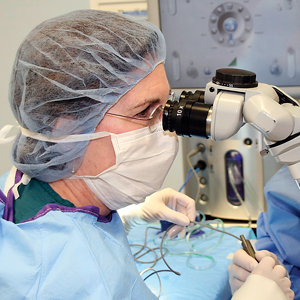
Closing in on sixty-five, Claudia Alicea, RN, a nurse in ophthalmology for thirty years, remembers when she started questioning her own vision. Will I have to drive home at night? Boy, those headlights look like sparklers. What do you mean, changing my glasses won’t help my vision? I’m having trouble making out names on patients’ charts from a few feet away.
Claudia had learned to live with a lot of these issues, but it was that last part that had her concerned. As an operating room nurse at Stony Point Surgery Center, her primary function was assisting ophthalmologists with many kinds of eye surgeries, including cataract surgery. “To be good at my job, driving in the dark wasn’t a necessity,” says Claudia. “Identifying a patient’s chart quickly and efficiently was.”
According to Claudia, in general, she started noticing that colors weren’t as bright, lights were glaring, and the images across the room were not as clear as they had been in the past, and, she says, “I needed extra light to do my paperwork with charts.”
Even though she had assisted surgeons every day while attending to patients with cataracts, it never really occurred to Claudia that she would be the one needing surgery so soon. Then, at her annual eye appointment, she heard the news that she was facing the same diagnosis as the thousands of patients she had helped over the years.Nurse Claudia had cataracts.
Andrew J. Michael, MD, is an ophthalmologist in Richmond who specializes in cataract and glaucoma surgery. With Claudia’s assistance over the years, he had performed numerous surgeries and procedures. Now Claudia would be the patient whose cataract would require removal.
Cataracts are changes of the natural lens of the eye that lead to distorted and diminished vision. Most cataracts are related to aging, but there are many causes, including eye injuries, heredity, and exposure to some medications. According to Dr. Michael, you don’t have to be pushing sixty to get the typical age-related kind of cataract. It can start in your forties or fifties, or even earlier in life. Cataracts in younger patients, however, are small and may not affect quality of life.
For Claudia, the process started a couple of years ago and was gradual—so gradual that she may not have noticed the changes until recently. The mother of two and grandmother was also starting to realize that she was having trouble distinguishing her own grandkids at sporting and dance events.
Dr. Michael says, “An early cataract requires no treatment other than observation and perhaps a change in glasses or contact lenses. However, once the cataract starts to affect quality of life, it is quite appropriate to have a thorough evaluation and reasonable to start thinking about treatment.”
The lens of the eye, behind the iris and the pupil, is very much like a camera lens focusing light onto the retina, which is like the film in a camera where the image is recorded. The natural lens can adjust the eye’s focus, letting us see things clearly both up close and far away, though this ability decreases as we age. The lens, which is also called the crystalline lens, is made of mostly water and protein. This protein is arranged in a precise way that keeps the lens clear and allows light to pass through it.
“As we age, the proteins in the lens change and can cause the lens to become cloudy. These changes often result in decreased vision because the lens is not clear, dimming of vision because less light passes through the lens, and distortion of vision because some areas of the lens can be more affected than others,” says Dr. Michael.
Researchers and doctors have found that there are many causes of cataract, such as lifestyle habits like smoking and drinking alcohol, and environmental factors, like prolonged exposure to sunlight, especially ultraviolet rays. People with diabetes are also at higher risk of developing cataracts.Most cataracts are related to our normal aging process. “This age-related cataract is the kind of cataract Claudia had, and it is the most common,” says Dr. Michael.
After a full eye exam and work-up was performed to rule out anything more Serious, Claudia’s cataracts were confirmed.She’s not alone. Cataracts affect nearly 20. 5 million Americans age 40 and older.According to some research, if you live long enough, you will have cataracts. And by age 80, the vast majority of all Americans do.
Claudia’s cataract surgery, which removed the cloudy lens and replaced it with an artificial lens, was quick and relatively painless.It is typical for patients who have cataract surgery to need no general anesthesia and no stitches. Claudia was awake during the procedure. “Technological advances in the instruments we use to perform the surgery and improvements in the artificial lenses we use to replace the cataract have been so dramatic that recovery is almost immediate,” says Dr. Michael.
Routine post-operative instructions may include using eye drops for two to four weeks after the surgery to reduce the risk Of infections and to minimize inflammation. Patients are typically back to their normal routine with little or no activity restrictions the day after surgery. Claudia feels that the surgery and the follow-up were certainly Worth it for her. “Now I don’t need glasses, except to read. My vision hasn’t been this good since I was a teenager,” says Claudia.
With a storied career in ophthalmology,Working first as an office assistant and later as a scrub nurse, she admits that for years she often wondered why so many patients waited so long to have their cataracts removed. “Now, here I was looking at the same issue, literally,” says Claudia. “After it was done, I realized right away that not only had my vision quality improved, but my overall quality of life was going to be much better too.”
Claudia says that she has witnessed firsthand the before and after of cataract surgery and the impact it can have on patients’ lives.
“I have had patients tell me they thought the purple outfit they were wearing looked brown before the surgery,” says Claudia, acknowledging the color confusion that often occurs with cataract patients. “Another patient said she thought she looked pretty good, until cataract surgery when she looked in the mirror and was able to see all of her wrinkles more clearly.” But the nurse’s favorite surgery story involves an older gentleman who told her he had thought his wife was “much better looking” before he had his very successful cataract surgery. “Thank goodness, his lovely wife was not in the room at the time,” says Claudia.