


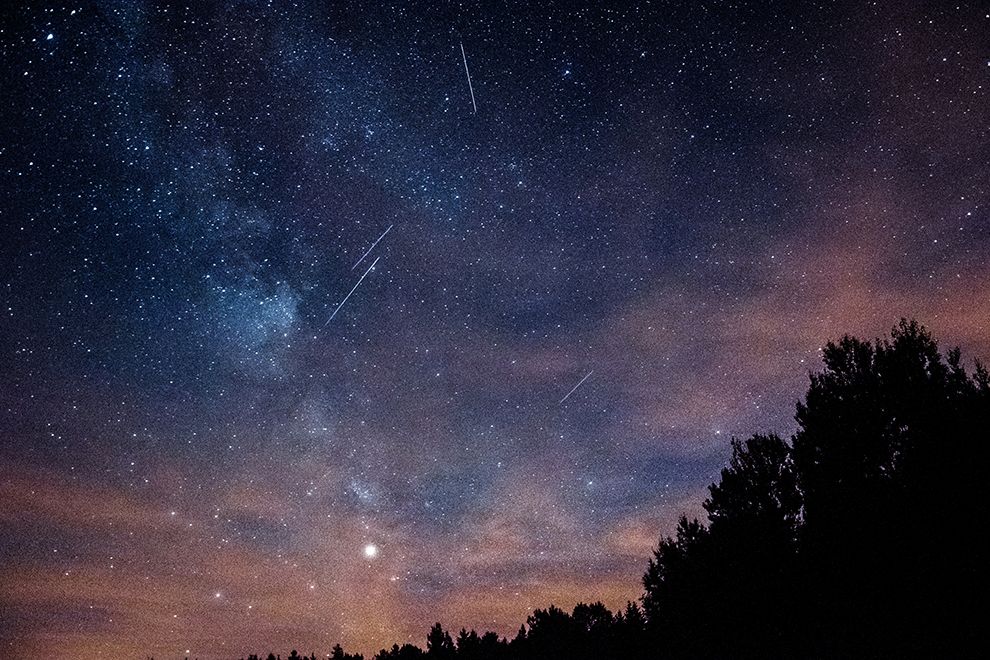
When you look up at the sky this fall and winter, there’s plenty to see: stars, planets, phases of the moon, and more. But with the right timing and knowing what to look for, Virginians can also spot meteor showers throughout the late fall months. These celestial events can be both dazzling and disappointing for observers, so you’ll want to know the dos, don’ts, and expert tips to get the most out of your meteor shower viewing.
What Is a Meteor Shower?
Meteors, sometimes called shooting stars, are short-lived streaks of light visible in the sky. They’re caused by small objects at high speeds entering earth’s atmosphere, where they’re vaporized due to friction with the air about 50 miles above the ground.
It’s normal to see a few meteors moving in random directions over the course of a night, but sometimes their number increases and they all appear to come from the same part of the sky – this is a meteor shower. The part of the sky where a meteor shower appears to originate from is called the radiant, and over time, each shower was named after the constellation in which its radiant resides.
In the mid-19th century, astronomers started to link meteor showers to celestial sources like comets. As a comet orbits the sun, solar energy warms its surface and causes dust and gas to be released. The dust grains get scattered along the comet’s orbit, and if the earth passes close enough to the comet’s orbit, we can see a meteor shower, even if the source of the dusty debris is very far away.
What to Know
To watch a meteor shower, all you need is a clear view of the sky and some time. No special equipment is needed – using binoculars or telescopes actually makes it harder to spot meteors as they streak across the sky. To see as many meteors as possible, you typically want to get outside in the early morning hours (for many showers, 2 a.m. is ideal) and keep watch for a while.
Astronomers estimate the strength of a shower by its Zenithal Hourly Rate (ZHR), or the number of meteors you could see while watching for one hour under perfect conditions (a cloudless sky, free of the glare from the moon, with the radiant of the meteor shower directly overhead). We rarely experience those ideal conditions, though, so you’ll probably find that meteors are a little less frequent than the ZHR seems to promise.
Meteor showers can be unpredictable and aren’t simple one-night events. If you miss – or sleep through – the peak hours of a meteor shower, try going out a little earlier – or later if you’re an early riser. You might also catch strong activity for a night or two before and after the expected peak, and some showers contribute a handful of meteors to our sky for weeks at a time.
These dates and times aren’t strict, but you can use these recommendations to fit with your schedule. Staying up to see these asteroid-powered spectacles is a special way to spend a fall or winter night. Make some hot cocoa, invite your friends and family, and take in the show in the sky.
What and When to Watch
The Main Event
The Geminids
Peak activity: Mid-December
ZHR: 120 meteors/hour
Radiant location: Gemini
The Geminids are one of the strongest meteor showers of the year and will peak on the night of Saturday, December 13 into Sunday, December 14. By the shower’s 2 a.m. peak, a lucky observer might see up to 120 meteors per hour, but it’s worth trying your luck well before that early morning crescendo.
As their name suggests, the radiant of this shower is in constellation Gemini. This year, the bright planet Jupiter will be near the Geminids radiant, making it easy to find. The moon will rise just as the Geminids are expected to peak, but in its waning crescent phase, it won’t be too bright to completely spoil the view.
While most meteor showers are caused by debris from comets, the Geminids have an unusual source: a near-Earth asteroid named 3200 Phaethon. It has an elongated orbit that carries it closer to the sun than Mercury, where solar radiation can fracture or even vaporize its rocky surface, lofting dust into space. When the earth passes near the asteroid’s orbit every December, these tiny fragments of Phaethon burn up in our planet’s atmosphere.
Other Opportunities
The Leonids
Peak activity: Mid-November
ZHR: 15 meteors/hour
Radiant location: Leo
This was the first shower to be successfully linked to its source object, a comet named 55P/Tempel-Tuttle. This year’s peak on the mostly moonless night of November 16–17 is expected to deliver 10–15 meteors per hour.
The Ursids
Peak activity: Late December
ZHR: 10 meteors/hour
Radiant location: Ursa Minor
For the Ursids, on the night of December 21–22, roughly 10 meteors are expected per hour, while the nearly new moon stays out of the way. This shower’s parent object is also a comet, named 8P/Tuttle.
These dates and times aren’t strict, but you can use these recommendations to fit with your schedule. Staying up to see these asteroid-powered spectacles is a special way to spend a fall or winter night. Make some hot cocoa, invite your friends and family, and take in the show in the sky.