Through August 2 (note, the end date has been extended due to popular demand), one of the rarest prints of the Declaration of Independence will be on view at the Virginia Museum of History & Culture (VMHC). On loan from Sweet Briar College, this print of the Declaration was recently determined by researchers to be one of only two surviving test prints for the first officially commissioned recreation of America’s founding document.
By 1820, the original 1776 Declaration had become faded and fragile to the point that there was concern it would become illegible and lost forever. Secretary of State John Quincy Adams commissioned preeminent engraver William J. Stone to begin the process of creating a duplicate.
Stone spent three years painstakingly recreating every pen stroke of the original onto a copperplate. The Stone Engraving, named for its crafter, was used to produce a limited run of 201 copies of the Declaration on parchment. These copies were distributed to the three surviving signers (John Adams, Thomas Jefferson and Charles Carroll), the Marquis de Lafayette, federal and state officials and several colleges and universities.
“As the basis for nearly all modern reproductions of the Declaration, William Stone ensured that both its image and its enduring ideals would survive for generations,” said the Virginia Museum of History & Culture’s Senior Director of Curatorial Affairs, Andrew Talkov.
Only 31 copies are known to survive. Until recently, the version on loan from Sweet Briar College was believed to be one of those copies; however, researchers recently determined that due to being printed on paper rather than parchment and a visible imprint left by the copperplate in the top right, this copy may be one of the six test runs created in preparation for the 1823 engravings — making it exceedingly rare.
The Declaration test print on display at the VMHC is one of only two known to still exist.
“The final month leading up to the passing of the Declaration of Independence was a consequential time for the aspiring nation,” said VMHC President & CEO, Jamie Bosket. “Virginians were at the center of this fervor. Richard Henry Lee, on behalf of the Virginia Delegation to the Second Continental Congress, stood among his peers, proposed American Independence, and changed the world. His motion, which was ultimately approved on July 2, 1776, set in motion the drafting of the Declaration. We are exceedingly proud to display this rare historical treasure as we mark these important American milestones.”
To commemorate the 250th anniversary of these formative moments, this rare copy of the Stone Engraving will be on view at the VMHC through August 2. Visitors can see the document in the Royall Gallery at the entrance to the VMHC’s marquee 250th anniversary exhibition, We The People: The World in Our Commonwealth.
One of the Rarest Prints of the Declaration of Independence on View at VMHC
The first major public display of Sweet Briar College's important historical document marks the 250th anniversary of Virginia’s motion for American Independence that led to the Declaration of Independence
 By RFM Team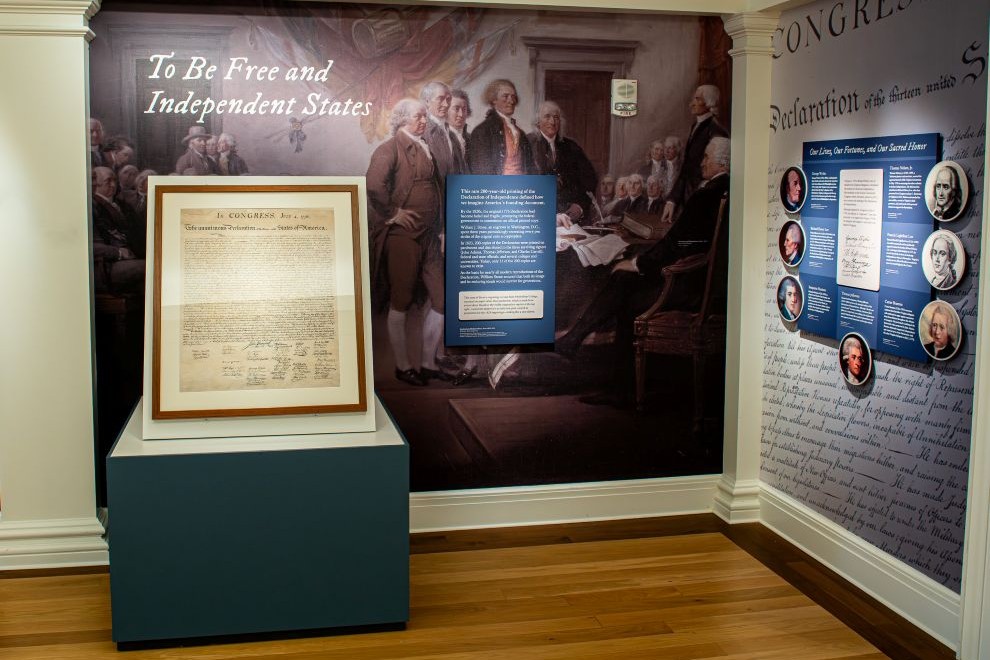
RFM Team
Digital editors and other staffers on the RFM team post content from resources in the Richmond region.
Advertisement
Advertisement
Advertisement
Explore More