

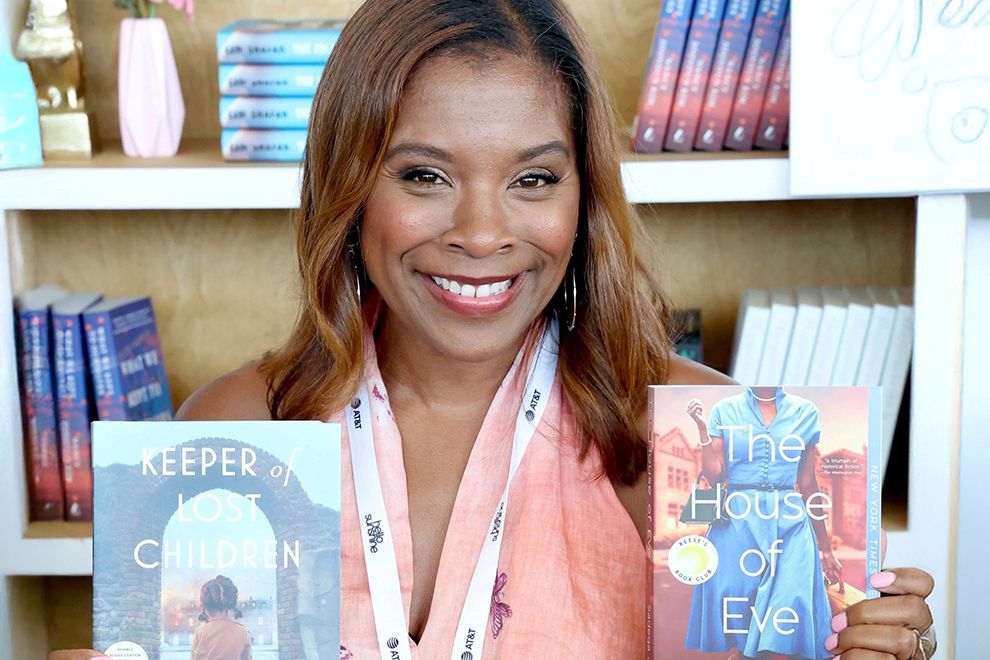
Local author Sadeqa Johnson sees herself as a conduit for the stories that choose her to bring them to life.
“Once I say yes to the story, I turn myself over to the characters and let them speak to me. I capture the story flowing through me and write it as beautifully as I can. I don’t feel like it’s me as much as me being open to tell the story I hear,” says Johnson, a New York Times bestselling author whose latest novel, Keeper of Lost Children, was released in February.
According to her husband Glenn, Johnson lives with her characters. “They stay with her. It’s her way of developing those characters so that they come to life on the page,” he says. “She pours her heart and soul into everything she does. I think you see that in her writing.”
Johnson also has a natural knack for finding incredible stories.
“She takes a kernel of history and turns it into a page-turning novel. She’s really good at character motivation, and she’s great at dialogue,” says her editor, Dawn Davis, of 37 Ink, an imprint of global publisher Simon & Schuster. “She knows her audience and how to keep them entertained.”
Storytelling Comes Naturally
Whether she knew it or not, Johnson began honing valuable skills related to being a novelist early in life. Her love of the arts and of reading were as natural to her as breathing. “I always remember reading,” says the Philadelphia native who would pass by the library on her way to school and check out a book to read. “It’s always been a habit, part of my routine.”
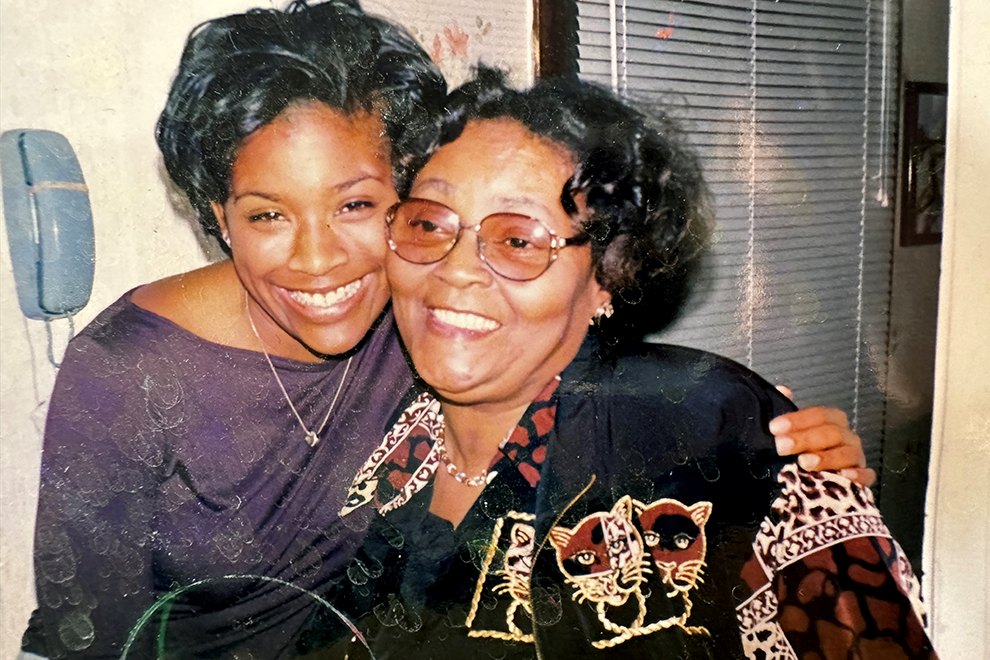
Johnson’s paternal grandmother Geraldine supported her granddaughter’s writing by keeping notepads at her house that Johnson would use to write little stories that became keepsakes for her grandmother. “I’ve always been writing and telling stories,” Johnson says.
Her life has long been powered by creativity. The oldest of four siblings, Johnson had a strong interest in theater and would put on a Christmas show at home every year. She would be the lead character, and her siblings served as cast members. As a teenager, Johnson also attended acting classes at The New Freedom Theatre in Philadelphia after school and during the summer. “I wrote plays and acted,” she says.
One of Johnson’s writing teachers in high school gave her sage advice that Johnson still lives by. “She said, ‘The first thing you need to do is learn your craft,’ and that’s what I tell my writing students today. Be all in and learn your craft,” Johnson says.
Davis sees that same dedication to learning in Johnson’s writing process today. “She does the research,” Davis says, noting that when Johnson began writing historical fiction, she studied the genre.
“She learned the craft, studied the beats of historical fiction. It’s not enough to find an interesting footnote in history. You have to make it resonate with the reader.”
Dawn Davis, 37 Ink
Johnson’s passion for writing remained strong throughout high school, but she ultimately decided to major in theater at Marymount Manhattan College. “I wanted to be discovered,” she says. “I thought I would just be there for a couple of weeks, and I would get my big break.”
But that’s not how it worked out. After two years, Johnson switched her major from theater to communications. Her one constant all through college was writing. She wrote everything from plays to poetry.
After graduating in 1997, Johnson landed a job at Scholastic, the world’s largest publisher and distributor of children’s books. She started off as a publicity assistant, then was promoted to publicist. She had the opportunity to work on publicity for the first three Harry Potter books. She also worked with children’s and young adult authors Virginia Hamilton and Walter Dean Myers, and she served as the publicist for author and civil rights activist Ruby Bridges.
Johnson moved on to work for G. P. Putnam’s Sons (now Penguin Books) and soon became publicity manager, working with authors such as Nevada Barr, Rebecca Walker, Tia Williams, Catherine Coulter, Bishop T.D. Jakes, and Bebe Moore Campbell.
Johnson also began writing her first novel, Love in a Carry-On Bag, while she was working at Putnam. She would write every morning during her train commute from New Jersey to New York City, and around 4 p.m., she would close her office door and type out what she’d handwritten on the train so she could revise it on the way home. She would also write on Saturday mornings. That was the beginning of a set writing schedule — a habit she continues today. “Writing is one of those things you have to practice,” she says.
Johnson learned a lot from working in publishing, but the most important lesson she took with her when she left that industry was how to become a published author. “I guess I’m unique as an author,” she says. “I know the behind-the-scenes of a publishing house. I can collaborate with marketing and public relations because of that background. It’s been helpful for me in moving my career forward. I learned a lot from those early days in publishing.”
The Path to Getting Published
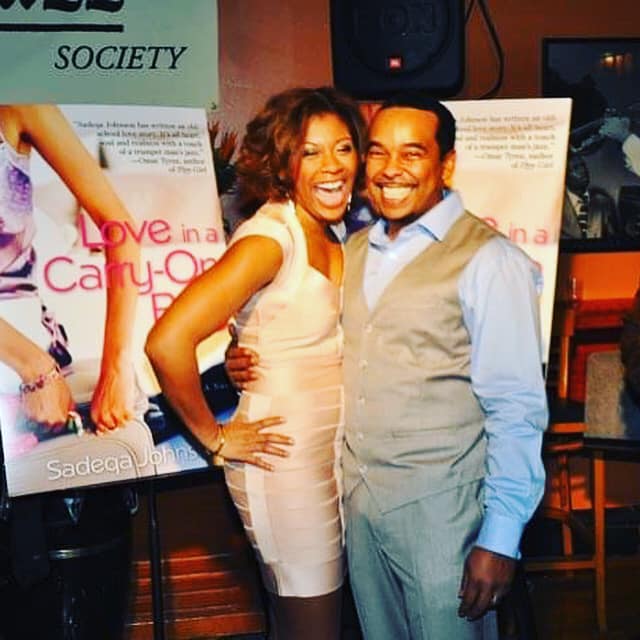
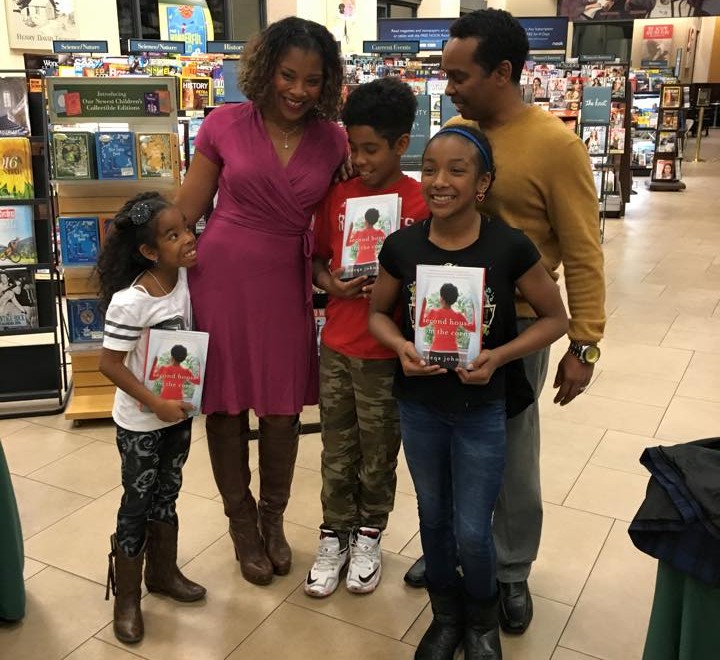
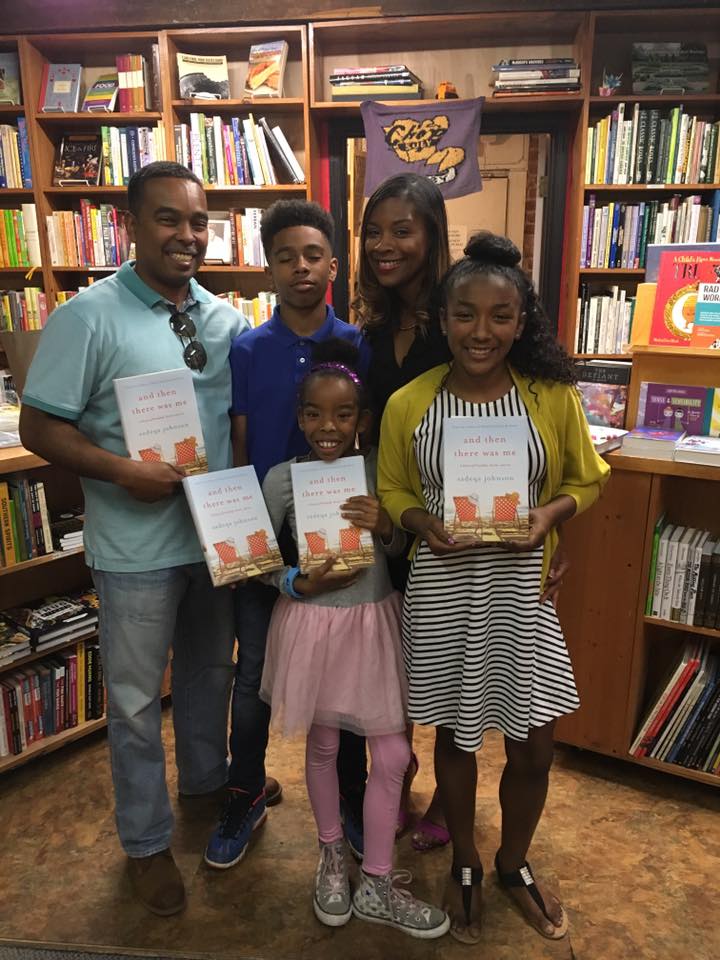
While Johnson had high aspirations, selling her first novel didn’t go like she’d hoped. The book was inspired by Johnson’s long-distance relationship with Glenn when they first started dating in the summer of 1995 while working at a TGI Friday’s in Philadelphia.
At the time, both were new to the restaurant and were always put in the same section, which was the furthest from the kitchen. “We started helping each other out with running food, then we were giving each other rides. By the time I was heading back to New York City at the end of the summer for my junior year of college, we were smitten with each other. We officially started dating that October,” says Johnson, explaining that they still saw each other on weekends in either Philadelphia or New York City.
Writers will often take an idea from something they’ve experienced, and that’s just what Johnson did in this case. “I knew publishing and long-distance love, and I mixed in fictional drama to make the story a novel,” she says. “I thought: ‘This is a beautiful beginning of a love story,’” Johnson says. “I hadn’t read any love stories at that point about a long-distance relationship, all the ins and outs.”
Once Johnson and Glenn were married and expecting their first child, Johnson announced her plans to quit her job in publishing to stay home with their son, finish her first novel, and become a New York Times bestselling author. “My husband was like, ‘Did you say you were going to quit your job?’” she recalls.
Johnson had an agent for the book, but even with an agent, it took a while for the book to be seen. “By the time the book was going to market to editors at the publishing house, I had three children at home,” she says.
Out of the eleven editors who read the book, ten told Johnson no, and one was a maybe that turned into a no. “I was holding my breath, but the editor was unable to purchase the book,” Johnson says. “I was really distraught. I had been working on the book for 10 years.”
Glenn couldn’t stand to see his wife defeated by this rejection. “I had my own business at the time, and I was accustomed to doing things on my own. So, I said let’s just publish it ourselves,” he says. “I wasn’t concentrating on sales; I was concentrating on seeing her dream fulfilled. I wanted her to experiencethat dream of being a published author. I would have put out anything to get that book published.”
Johnson reluctantly agreed, even though she had always dreamed of having a big publishing company behind her. Glenn got the staff from his business involved, and they were off and running. “It was a real family environment, so when we started our small publishing company, 12th Street Press, his staff from Right Away Bail Bonds was involved,” Johnson says. “His assistant made T-shirts for us with Love in a Carry-On Bag on the front to wear to the Harlem Book Festival — our first book event. The staff came and helped us hand-sell the books.”
Love in a Carry-On Bag came out in the summer of 2012, and the couple took it to every book fair and festival in the northeast corridor, from Boston to Washington, D.C. “We hit everything,” says Glenn. “We blanketed the corridor, and we sold books. I still have a couple of the T-shirts we made that I still wear.”
The couple continued selling at book fairs and festivals for about 18 months. “That was how I got my start,” Johnson says, adding that sometimes she would disguise her voice and use an alias to pitch the book to store owners. “There was a lot of behind-the-scenes work. It was a good steppingstone, but I wanted more. I wanted to have a larger reach. I needed the machine of a publishing house behind me.”
Johnson was already working on her next book, Second House on the Corner, when she was selling the first book. The story, which features a character who talks honestly about the ins and outs of motherhood, stemmed from Johnson taking her kids to the playground and watching other moms glorify motherhood.
“No one ever talked about how hard it was and those dark moments. I love being a mom, but sometimes it sucked,” she says. “I mixed in stories that my paternal grandma told me. She was a great storyteller.”
Johnson’s agent took the second book to market to editors. “I went from a girl that nobody wanted to publish to three different publishing houses wanting to publish this book,” she says. “I was ecstatic. I had arrived. I was one step closer to my dream of becoming a New York Times bestseller. I knew this was the start of something amazing. My career was about to take off.”
A New Chapter in Richmond
In 2015, Johnson and her family moved to Richmond from New Jersey on a whim. “We were already in the process of looking for a new home,” she says. “I had this feeling that we weren’t supposed to be in New York, that we were supposed to be somewhere else.”
The couple were not strangers to Virginia — both of their families have roots in Virginia. “My dad’s family was from Amherst County, and my husband’s family was from Nelson County,” Johnson says, adding that once they settled in the Richmond area, she kept asking herself, “What am I supposed to do? Why am I here?”
The answer came about a year later in April 2016 when Johnson’s friends visited from New Jersey and she suggested walking the Richmond Slave Trail. Her kids started reading markers along the trail, and they found a marker that briefly mentioned Robert Lumpkin, a cruel slave trader whose mistress and eventual wife Mary Lumpkin was an enslaved woman. “I could feel the hairs on my arms stand up,” Johnson recalls. “I was so taken by her story. I started thinking, ‘Why wasn’t there a book on this?’”
Because she had only written contemporary women’s fiction at the time, Johnson admits she didn’t feel qualified to write historical fiction. “We continued on the trail, and we were at the sacred African burial ground walking across the field, and I could feel the energy of the ancestors,” she says. “I felt like the ancestors were waiting for us. I said, ‘I think they want me to tell their story.’ That was the shift in my career, in consciousness for me of what I was to do with my creativity and what I was meant to do with my writing.”
Johnson felt possessed by the story. “I felt like the ancestors got in the car with me and followed me home. They were pushing me and nudging me to tell this story,” she says. “I felt overwhelmed by the responsibility of it but not qualified. A friend told me the thing that scares you the most is what you should be doing next. That gave me the courage to write the story Yellow Wife.”
Johnson researched the early to mid-1800s for six months before she started writing. “Researching was a little like putting the pieces of a jigsaw puzzle together,” she says.
In the process, Johnson discovered she loves uncovering untold stories. “As a historical fiction author, my mission is to shine a light in these dark spaces where history has been warped, misrepresented in some way. I wanted to bring them to light,” she says. Yellow Wife went on to win the Library of Virginia’s 2022 Literary People’s Choice Award along with other designations that include NPR’s 2021 Books We Love list and a Barnes & Noble monthly pick in January 2021.
After Yellow Wife, Johnson went on to write The House of Eve, which became her first New York Times bestseller in 2023. The House of Eve was also selected as a pick for Reese’s Book Club, Target Book Club, Library Reads, Indie Next List, Apple Books, and more.
The research Johnson did for The House of Eve is also what gave her the idea for Keeper of Lost Children. The House of Eve was inspired by stories of the struggles her maternal grandmother Yvonne Clair faced when she became pregnant at 15 in the 1950s. When Johnson started conducting research, she came across maternity homes. “It was another thing about women’s history I didn’t know anything about,” she says. “I felt fired up. I had to expose this moment in history when women were sent to these homes and had to give up their babies.”
As she scoured through related information, she discovered the documentary Brown Babies, which chronicles the legacy of Mabel Grammer, a Black journalist and socialite married to a chief warrant officer in the Army stationed in Mannheim, Germany. Grammer, who was unable to have children, stumbled across a home for mixed-race babies, many orphaned by transferred African American soldiers who had fathered the children with German women.
“Mabel was appalled and adopted 12 of the children,” Johnson says. “She also started the Brown Baby Plan to have these children adopted. When I learned about her story from the documentary and a New York Timesarticle, I thought, ‘Here is another woman in history who has done something extraordinary, and people don’t know her name.’”
Once Johnson committed to writing Keeper of Lost Children inspired by Mabel’s story, she traveled to Germany for a two-week research trip. She visited an Army base, museums, and cemeteries while she was there. She immersed herself in the land and the culture. She walked the streets, photographing locations that were relevant to the story. “I wrote notes to myself so that when I got home, the setting was still robust so I could write this story,” she says.
Her husband, Glenn, accompanied her on the trip. “It’s a little surreal to go back in history,” he says. “Sadeqa is very serious about her research. She wants to find out what actually happened. She wants to have creative freedom but still be true to the story.”
The Heart Behind the Work
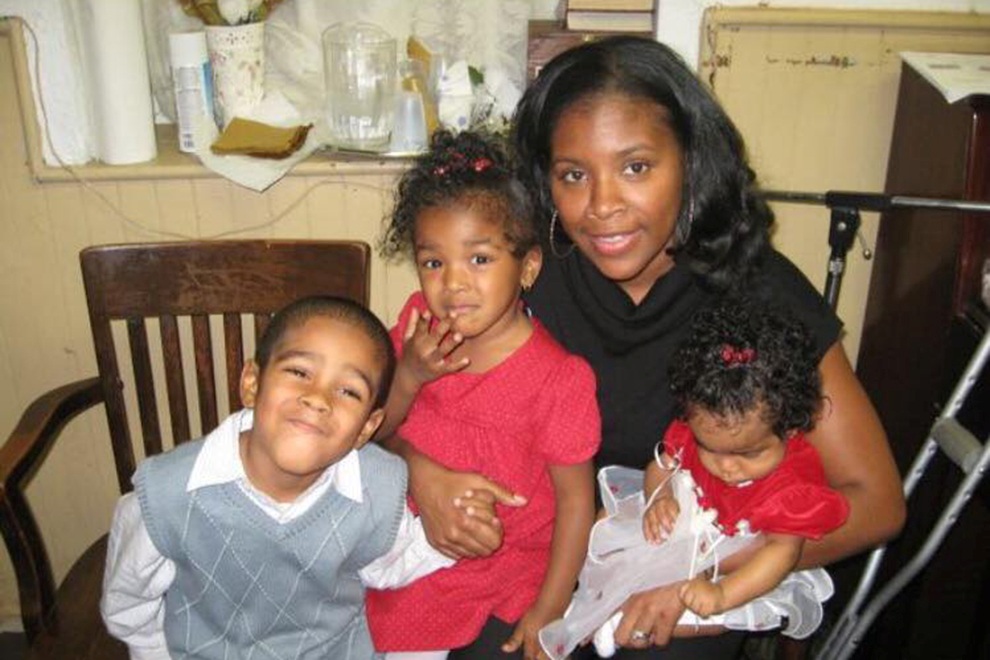
Johnson’s husband describes his wife as the most dedicated person he knows. “She’s dedicated to her craft, always nurturing her creative spirit. And she’s dedicated to her family,” he says.
Johnson and her husband have been together for 30 years and married for 23 years. The couple has three children — their son Miles, 22, who’s a senior in college; their daughter Zora, a 20-year-old junior in college; and their daughter Lena, 17, who’s a senior in high school. Johnson doesn’t believe any of them will go into writing. “My son is into computer science. My middle daughter is creative. She aspires to have a career in fashion. My youngest daughter loves writing but describes my life as torturous. She thinks being a writer is so difficult,” Johnson says.
When the kids were young, Johnson would hire a babysitter to come to the house from 4 until 6 p.m. daily so that she could do her writing in the basement. As they got older, she would write during their school hours and be present when they were at home. “When I was writing The House of Eve, it was the beginning of me going away to solo writing retreats for days at a time so that I could focus on my work without constantly being interrupted with the thoughts of making dinner,” she says.
Johnson enjoys sharing her passion for writing with others and now often teaches at writing retreats around the world. “It merges two things that I love most — travel and writing,” she says.
“When I get to teach at writing retreats, it’s a beautiful marriage.”
She also occasionally teaches creative writing virtually for Story Summit, a writing school that offers classes, events, and writer spotlights.
Additionally, Johnson has taught Historical Fiction and Dialogue at Drexel University and served as a writing mentor for students in the MFA program there.
Johnson acknowledges that there are days when writing can be hard. “[There are] days when I walk away and say, ‘This really sucks. I probably should abandon ship right now,’” she says. “And there are days when it is singing and it’s feeling good, and I walk away from the computer and say, ‘Wow I did that; that is awesome.’”
Even though every day is different for her, there is one constant that propels her through the days that she says feel like “trudging through the snow with no boots.” That constant is her devotion to writing. “I love being a writer and telling stories. I love bringing stories to life, particularly about people who have been marginalized or forgotten,” Johnson says. “I love the moment when I am writing and completely lose track of time. I love the whole process.