

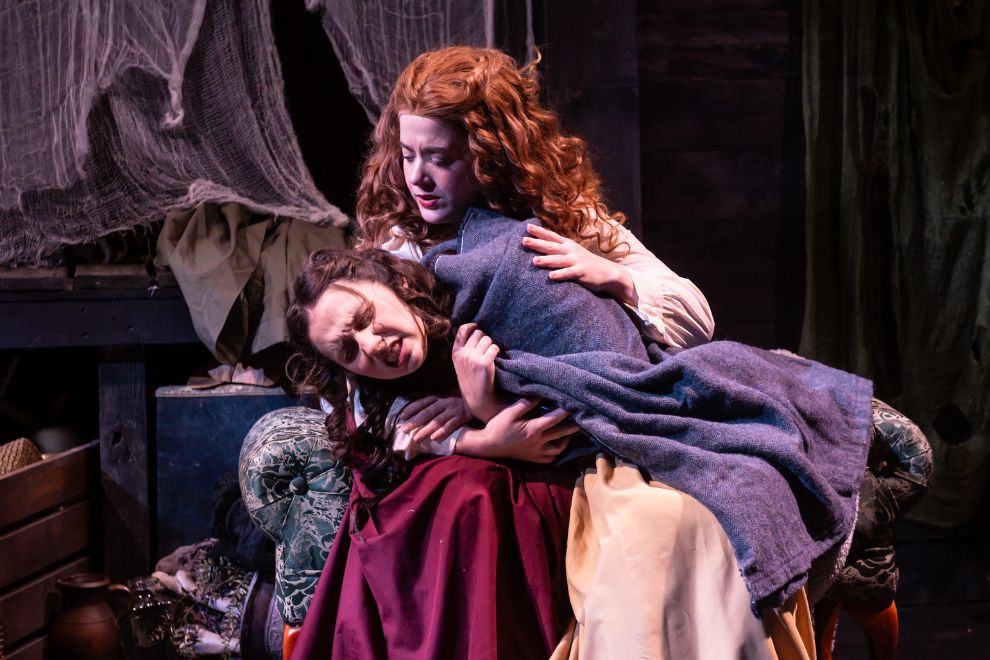
As a horror-obsessed girl and then adult, Mary Shelley’s Frankenstein has always been a strange knowledge gap for me—but Shelley’s biography has not. I never read Frankenstein, but as a child, I proudly parroted the facts I had learned: that the science fiction genre was created by a teenage girl. That Frankenstein began as part of a competition posed by Lord Byron to write a ghost story during a summer vacation with friends. That her mother was a famous feminist who had written an important treatise on women’s rights. And that, while historically overshadowed by her poet husband in the literary canon, Mary Shelley’s work has captured readers’ interest and continued to grow in popularity and esteem over time.
David Catlin’s play Mary Shelley’s Frankenstein exhibits a similar fascination with Shelley as an individual and writer. Rather than straightforwardly adapting the story of Victor Frankenstein and his creation, Catlin’s script centers Shelley as the main character in her own right. Pulling from the well-documented circumstances under which Shelley began writing Frankenstein, Catlin’s story begins with the author and her companions on their summer trip to Geneva.
Catlin’s Inventive Approach to Authorship
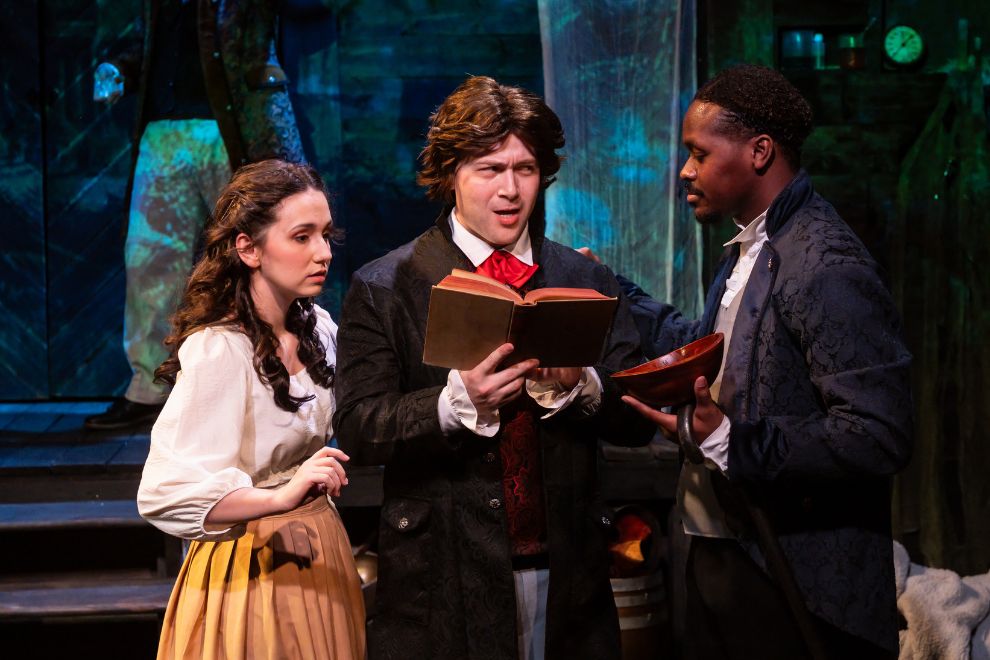
This cast of historical characters—Shelley, Percy Bysshe Shelley, Lord Byron, Dr. John Polidori, and Claire Clairmont—perform Shelley’s story as she writes it. The boundaries of authorship collapse as the figures break character and attempt to exert influence on the story. Still, Mary Shelley is always at the center. She deftly redirects the players into her vision. She also determines the moments that they all snap out of the Frankenstein narrative and back into the Geneva mansion. These moments of disruption are rooted in Shelley’s trauma and grief. Her companions’ obliviousness and their minimization of this anguish throughout the play highlights her precarious position as a romantically entangled and unmarried young woman in the Regency period. Catlin’s script explores her feelings of isolation and personal pain as key influences in the writing of Frankenstein.
Catlin’s framing device shifts the adaptation from a straightforward retelling to a thematic exploration of creator and creation. It maps Mary Shelley onto each of her characters, inviting the audience to make connections between her biography and the difficult lives of Elizabeth, Victor, and the Creature. Because all the Frankenstein characters are played by Shelley and her companions, it also encourages comparisons between those individuals. As Victor Frankenstein, Percy initially believes he is the story’s hero. He only realizes as the plot winds down that his status may be more complicated.
The approach is very compelling. It feels like it must be an English teacher’s dream, making explicit the emotional and social context in which the author wrote her novel. It supplements Frankenstein’s already clear and engaging themes about death, grief, creation, and our moral obligations. Foster Solomon’s direction and the cast members’ performances also animate this framing device with layers of characterization and comedy. The characters-playing-characters flirt, complain, and disrupt Shelley’s narrative as they perform. They are very funny, using props and exaggerated swagger to entertain and underscore the lack of seriousness in their engagement with Mary Shelley and her point of view.
Each performer excels on this front, turning up the volume on their comedic caricatures of Romantic-era hedonism. Travis Williams shows impressive range as the self-indulgent Byron and plaintive Creature. Rachel Garmon-Williams is particularly good at meeting the fast-moving demands of multiple roles, playing the most parts in the Frankenstein story and making them funny, exciting, and simultaneously distinct from one another and clearly Claire.
Showing the Unraveling Nature of Grief through Stagecraft
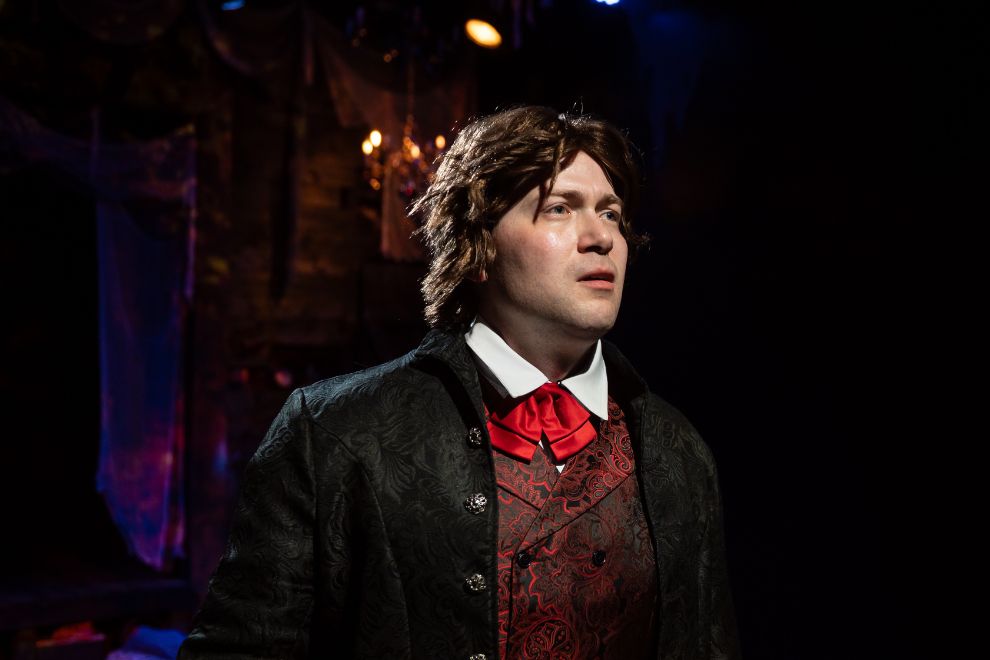
As the story progresses, the adaptation becomes generally more restrained and focused on performing the novel. Interruptions come less from Shelley’s bawdy companions and more from her own sharply-felt trauma pulling her out of the immersive writing process. I felt these moments were some of the weakest in terms of dialogue, but they serve well to shift the tone over time, especially with the help of some striking sound design. The production, like the plot, builds in intensity as it reaches its tragic conclusion.
Suspense and Fright in Frankenstein
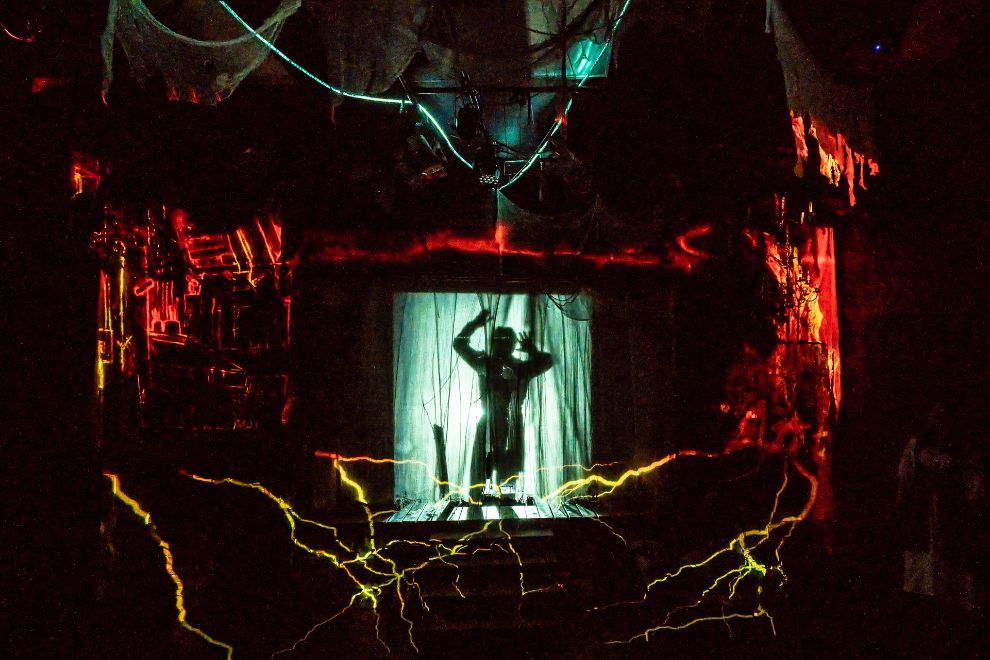
This production emphasizes Shelley’s literary themes of loss and alienation, but it is still Frankenstein, and it’s October. Richmond Shakespeare brings plenty of delightful, scary moments along the way. The sound design is intense. The stagecraft is great and allows the players to do a lot in a small space. I really enjoyed the translucent curtain at center stage, which cast an eerie and mysterious effect on the action happening behind it. Same with the trap door, which enabled some memorable, fun moments of suspense and horror. Costume designer Nancy Coles also brought the Halloween spirit to this production with a legitimately unsettling Angel of Death costume. It appears in several haunting moments to punctuate Victor’s descent, and I can picture it vividly days later.
Under Foster Solomon’s direction, Richmond Shakespeare’s Mary Shelley’s Frankenstein faithfully hits the beats of Shelley’s enthralling, thematically rich science fiction story. It is also an ambitious adaptation, expanding the storytelling scope from Shelley’s novel to her life and environment. The relationship between the two stories shifts in balance during the play, losing some of the entertainment and comedy of the earlier scenes as Shelley’s grief becomes more central and her companions fade away. But throughout, it adds further interest and depth to the telling of a story that already stands the test of time alone.
Fun and frightening scenic design, projection, and props, dynamic performances, and a clever format make this a rewarding interpretation for Frankenstein fans old and new. For viewers like me, with relatively limited exposure to Frankenstein beyond its general presence in pop culture consciousness, it’s a great introduction to the content of Shelley’s novel.
Mary Shelley’s Frankenstein runs at the (very cool) Theatre Gym at Virginia Rep through November 1. The play is in two acts. More information and tickets can be found on the Richmond Shakespeare website.