

Halina Zimm tells her life story as often as she can, wherever she can – whether in schools, in educator training sessions, or at the grocery store. Hers is a tale that not many can tell: The 96-year-old Richmond resident is one of roughly 40,000 Jewish people living in the United States who survived Adolf Hitler’s campaign to create a “pure Aryan race” (a fallacy of Nazi ideology) through systematic mass murder – what is now known as the Holocaust.
“Not all victims were Jews, but all Jews were victims,” Zimm says. “It is my obligation to speak for those who died, because they cannot speak for themselves. I am their voice.”
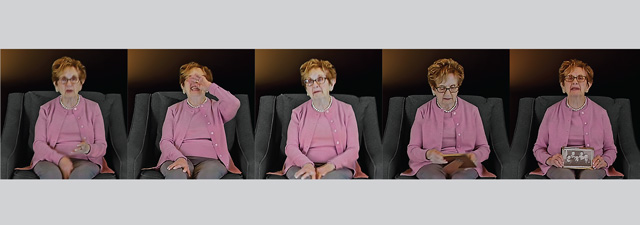
Zimm’s voice will soon have the potential to reach even more people. Her story – plus the memories of three other survivors and a U.S. serviceman who helped liberate Gunskirchen, a subcamp of Mauthausen Concentration Camp – is part of a new exhibit at the Virginia Holocaust Museum (VHM). Dimensions in Testimony at the Alan and Halina Zimm Theater of Remembrance gives visitors the chance to hear from survivors and ask questions about their personal experiences.
“The Virginia Holocaust Museum’s mission is to preserve and document the Holocaust in our community and across the Commonwealth of Virginia,” says Sam Asher, the museum’s president and executive director. “We think [Dimensions in Testimony] will bring in a special group of visitors who want to talk with Holocaust survivors. We feel this will expand our reach.”
In fact, VHM’s theater setting for the exhibit is only one of four such presentations nationwide and the first on the East Coast.
Keeping Stories Alive
As head of the Nazi party and eventually dictator of Germany, Hitler sought to eliminate Jewish people and others deemed to be problematic: gay people; those of certain racial or geographic backgrounds, including Black people and Roma; people with mental or physical disabilities; and those who followed other religions that didn’t support Hitler’s mission, such as Catholics and Jehovah’s Witnesses.
The Holocaust Encyclopedia, maintained by the United States Memorial Holocaust Museum, estimates that three million people – in addition to the six million Jews killed – also died from 1933 to 1945.
While more than a dozen Dimensions in Testimony exhibits are in place at Holocaust museums and education centers across the United States, most are viewed via flat screens. The museum chose to build a new theater that features an illusion technique called Pepper’s ghost. Asher had seen the approach at the Illinois Holocaust Museum and Education Center in Skokie years ago and says he was inspired to use the same tech at the VHM installation. “Flat screens absolutely do not do [the survivors’ testimonies] justice.”
The Pepper’s ghost technique involves projecting an image onto an angled piece of glass or screen that makes it appear as though the person or thing depicted is real. Often mistakenly called a hologram, it was a Pepper’s ghost illusion that appeared to bring the rapper, Tupac Shakur, to life onstage at a 2012 music festival. Teleprompters also use Pepper’s ghost techniques.
The interactive biographies for Dimensions in Testimony were developed in 2014 at the USC Shoah Foundation, a nonprofit dedicated to recording and sharing the stories of Holocaust survivors. The biographies use advanced filming techniques, specialized display technologies, and next-generation natural language processing so audience members can ask questions in real time that are answered using information from the survivor’s previously recorded interviews.
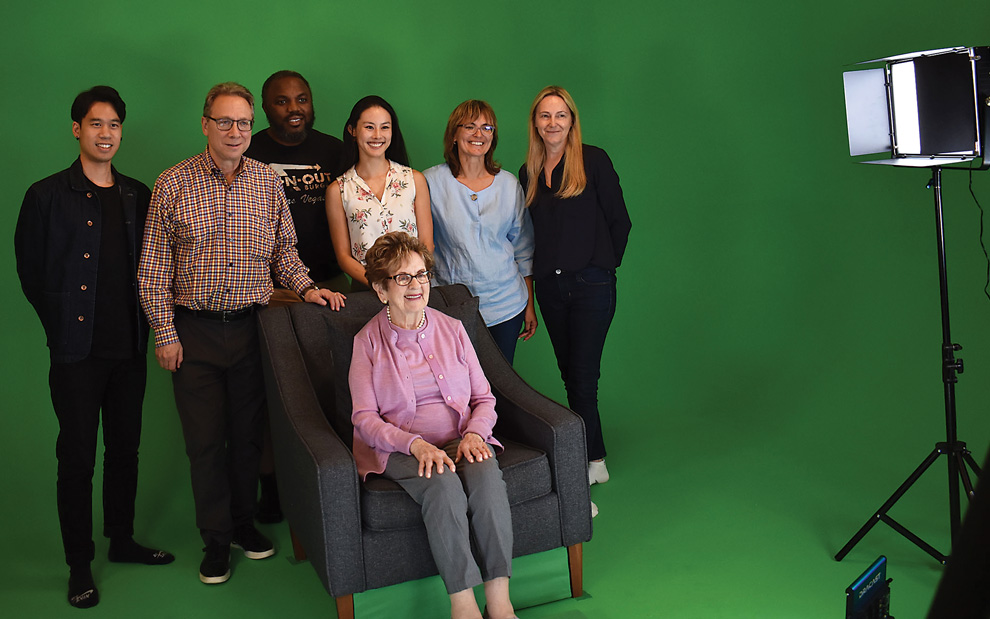
To make the interactive biographies as comprehensive as possible, the team starts with a list of standard questions and adds other queries prompted by speaking engagements or interviews the survivor may have given elsewhere. For the actual taping, the survivor is interviewed six hours a day for five days, answering more than a thousand questions. Survivors are seated – almost all of these folks are older than eighty – wear the same outfit every day, and try to be as still as possible to minimize breaks in playback. Every response is recorded.
“We use artificial intelligence to match user questions with recorded testimony of the interviewees,” says Catherine Clark, PhD, senior director of programs for USC Shoah Foundation. “This is not ChatGPT – we are not creating something out of nothing. We’re using machine-learning pathways to take a question that isn’t always worded the same way and pair it to the segments of the interview responses.
“We want to make sure we build something that is going to provide the best holistic sense of [the survivor’s] life story, their experience during the Holocaust, and life afterward,” Clark adds. “We’re trying to figure out ways to help survivors tell stories for future audiences.”
While the technology might attract the curious, there is more to be learned. “The whole point of a conversation is that it’s human-driven,” Clark says. “It’s coming to someone and asking questions and then asking more questions. That engagement is what makes [Dimensions in Testimony] more than a video. The [audience member] standing there can drive the conversation and open their mind to this other person’s experience.”
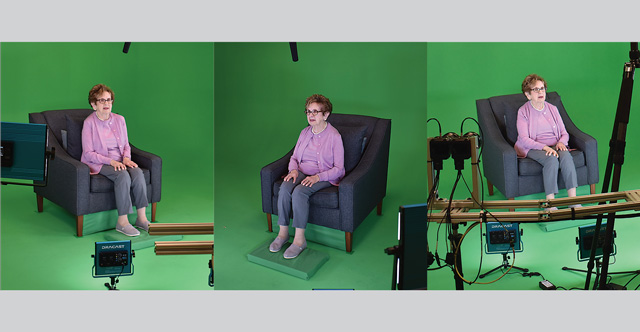
After recording, the interview is assembled and goes through hundreds of hours of beta testing. When an answer doesn’t seem to match the question asked, that response is flagged, signaling to the system that it has to do better. The system will continue to “learn” as it’s used, which means that a survivor’s answer can change slightly over time.
Along with Zimm’s testimony, the VHM will present interactive biographies from survivors Pinchas Gutter, Eva Kor, and Anita Lasker-Wallfisch, as well as Alan Moskin, a Jewish American veteran. “The other interviews have been around for years, so they are less likely to have a faulty response [to a question],” says Kate Adams, the VHM’s director of public and student programs. “A new question [posed to Zimm] formed in a different way might not have the best answer yet.”
Voices of History
Genocide originated as a legal term in 1944 to describe deliberate actions to eradicate a specific group of people, identified by race, ethnicity, or nation of origin. Since the Holocaust, other genocides have occurred – in Armenia, Rwanda, and Cambodia. The Virginia Holocaust Museum maintains 226 oral histories from survivors of genocide, all of whom have a connection to Virginia. The museum reaches between 45,000 and 50,000 people yearly through in-person visits, teacher workshops, educational outreach, and speakers.
In 2021, with its twenty-fifth anniversary on the horizon, VHM launched a $2.5 million capital campaign. Goals included upgrading HVAC and security systems in their 1899 Tobacco Row building in Shockoe Bottom as well as improving the guest experience with a new reception area and museum shop. As part of the campaign, Asher approached a longtime museum donor with a specific plan.
“He had said he wanted to do something different,” Asher says of the anonymous supporter. “He’d already seen the 60 Minutes segment about Dimensions in Testimony [from a different museum] and was ecstatic.”
Asher wanted to include a local person’s interactive biography and approached Zimm, who speaks at the museum’s Alexander Lebenstein Teacher Education Institute, a summer program for middle and high school educators. Would she sit for the necessary interview, he wondered?“
I said no initially,” Zimm says. “I was afraid I wouldn’t be able to do it, because the attention is all on you.”
But Asher was persistent and enlisted the help of Zimm’s children and others who knew her. “The more I heard from people, the more I thought, ‘I am going to do it,’” Zimm says. “I know the others don’t have a story like my story.”
Asher agrees: “Whenever she’s out and about, and someone says, ‘Who are you?’ she says ‘I’m a Holocaust survivor,’” he adds. “It doesn’t matter if she’s in a grocery store or dry cleaners. She’s taken it on as a raison d’etre that she has to speak.”
Zimm’s filming occurred in Richmond in May 2022. “It wasn’t hard to sit there, because I loved the people [working on set],” Zimm says. “I felt patience and kindness from them. I yapped so much, sometimes I said things they didn’t ask me [about]. This is something [that will last] forever. I’m not going to be here forever, so this is for posterity. People must know. This is a part of history.”
Theater’s Debut at VHM
Zimm’s interactive biography is the first to be presented in the Alan and Halina Zimm Theater of Remembrance, named to honor Halina and her late husband Alan, who was a tailor for many years in Richmond. The other interactive testimonies will follow in coming months. Adams encourages visitors to check the museum’s website before their visit to see which survivor testimony is currently being offered. The use of the Pepper’s ghost method means technical and sound settings are unique to the presentation of each interview, so the monthly rotation will save the VHM staff time by not requiring daily or weekly adjustments.
The museum doesn’t charge an admission fee but suggests a $10 donation. The Dimensions in Testimony showing, about forty-five minutes long, will be free for visitors from November 1 until the first of the year. After January 1, 2025, non-VHM members will pay a nominal fee to view the exhibit. The fee will be waived on Holocaust Remembrance Day on January 27, 2025.
Because the theater has forty-six seats, timed reservations are required. Visitors are seated in rows as they would for a movie showing, with a low stage at the front of the room. Drapery surrounding the stage conceals the mechanics of the Pepper’s ghost illusion, but a real table and lamp are on the stage to enhance the setting.
A museum facilitator starts the presentation by introducing the survivor and giving some of his or her story. Then, the survivor’s image appears, sitting in a chair next to the table. The survivor is asked to tell their story. Following those initial remarks, audience members may ask the facilitator to pose additional questions, which can range from the practical – such as what food the survivor ate during the war – to the whimsical – such as asking the survivor to tell a joke.
For clarity, some questions may be rephrased.
“At a preview, a board member asked a four-sentence question about very specific antisemitic groups that are now operating in Germany,” says Adams, the museum’s program director, noting that complicated questions may need to be simplified so it can better match a question that was asked in the initial taping session.
VHM staff members hope exhibition participants will be respectful while interacting with survivors’ testimonies, but want visitors to remember that the survivors chose to participate. “AI will help in the post-survivor world,” Asher notes. “Each person’s experience is completely different, which is why we need to hear as many stories as we can, while the survivors are here to share them.”
USC Shoah Foundation’s Clark agrees. “As we lose a generation, we lose stories,” she notes. “If we don’t have first-hand accounts of the Holocaust, I fear we are at greater risk of the type of distortion and denial that is happening right now.
“Think about Halina [Zimm],” Clark adds. “There were 3.3 million Jews in Poland before Germany invaded. At the end of the war, only approximately 380,000 survived. There are so many people whose stories we don’t have.”
Zimm has previewed her testimony and hopes that families will visit the museum to continue learning.
“My mission is that people must know there was a Holocaust,” she says. “People are trying to erase it, but I was there, and I’ve seen it. I’ve seen the bad and the good and the beautiful. Above everything else, I believe in people, and I believe in love. Never hate – always love.”
Find out more on the Virginia Holocaust Museum’s website.