

Q: “I’d like to start teaching my 13-year-old about responsibility now that he’s growing up. What are some easy, age-appropriate chores to have him help with?”
A: The good news is it’s never too late to start teaching your child about responsibility and helping around the house. No matter the age, the beauty of a child who contributes to their family and home has nothing to do with chores in the literal sense but with the early development of a healthy self-regard. Our self-perception during childhood has everything to do with how we contribute to our family, classroom, neighborhood, etc. A 13-year-old who has not yet started to contribute has the perception that “You give. I receive.” A reasonable expectation for a child to help with daily responsibilities will disrupt this long-lived perception, so don’t be afraid to dive in.
First, let’s consider the word “chore.” Just the word chore makes kids think of punishment. And that association is usually born from the parent’s attitude regarding chores — “I can’t do it all myself. I need help around here. I need a break.” These messages make chores a very negative experience for the child. It becomes about parental burnout, and the child’s response to that is often resenting having to “bail out” the parent. That’s not at all why children should have chores. When a child is given responsibility, it should be given in a positive context, such as, “This is such a huge help to our family!” or “I hope you feel super good about your help today. I do!” Children love to help. Helping makes them feel capable, and capability makes a child feel confident. That’s the magic.
At 3 years old, your child’s emotional development begins to explode. Emotional development refers to a child’s perception of themself in their small world. Their perception of themselves drives their social development and how they engage with the world. This dynamic continues throughout life. Now, don’t we want a confident, competent child engaging with the world? Absolutely. Children become confident when they help and contribute successfully.
A great example of this dynamic is potty training. When a child is 2 years old, most are ready to transition out of diapers. That training is met with much resistance, and typically, well-intentioned parents back away because of the child’s distress, assuming they’re not ready yet when really that pushback is only a child’s natural response to their changing role. Being toilet trained shifts a certain responsibility from you onto them, which causes discomfort because they lack the confidence to accept that responsibility. There is only one way to fix this, and that is to push forward. Children learn they can do it, and learning they’re capable feels great. Using the toilet is a skill of self-reliance, and skills of self-reliance are at the very core of an emerging and rapidly developing self-regard.
Because the child is helping their family and making their home better by assuming some level of responsibility.
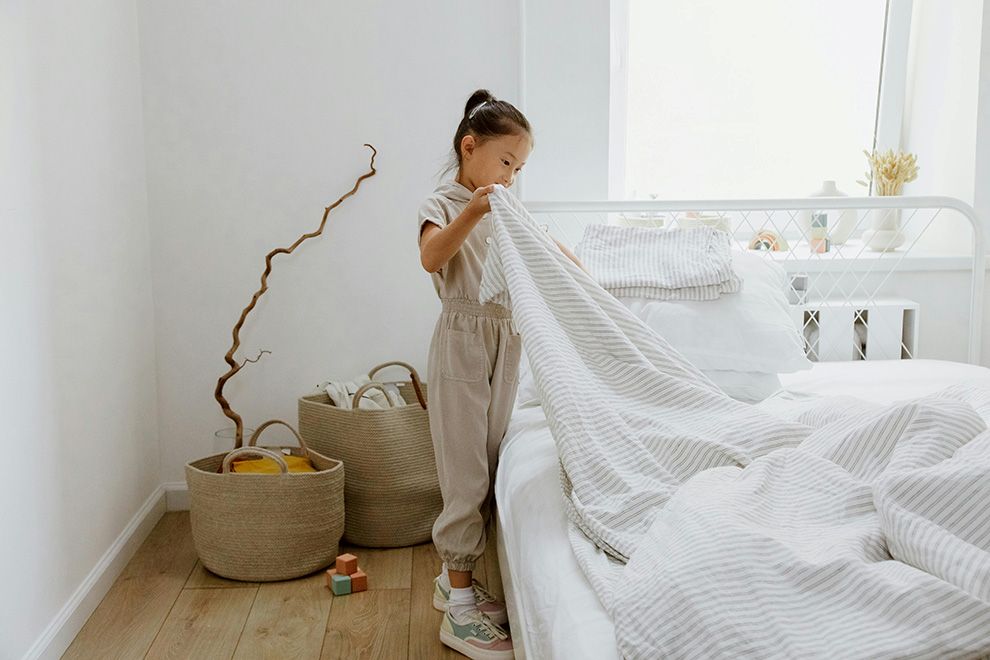
There are different developmental abilities of your child at every stage that can inform the jobs they’re capable of taking on at home. Young children contribute by doing tasks like picking up toys one toy group at a time, taking their plate to the kitchen, putting their dirty clothes in a basket, or feeding food to a pet. They can learn anything if you break it into bite-sized jobs and really teach that skill. From age 4, children can put their clean laundry away and clear a table and rinse dishes. An 8-year-old can do their own laundry, walk and feed pets, and assist in the kitchen or with the lawn. A 13-year-old is capable of successfully contributing anything they are taught.
Children must experience success in contributing, and that contribution must come from a positive and encouraging teacher. If a parent makes chores all about how burdened they are, then the child gets the very clear message that working is bad, therefore helping will be resisted. But when a parent takes the time to explain the value of helping and teaches the child how to be successful, work becomes a positive experience for the child. The focus should not be on the chore itself, but on creating a climate in the home where contributing is rewarding and valued. Chores should never be about us parents, but rather a vehicle to self-confidence in our children.
Children who learn how to be successful first in their own home are much more likely to be successful outside of their home. Helping is important to the development of our child’s sense of self and general competence, and an early start means they’ll grow up knowing that helping is their lifestyle, not something they only do on occasion.