
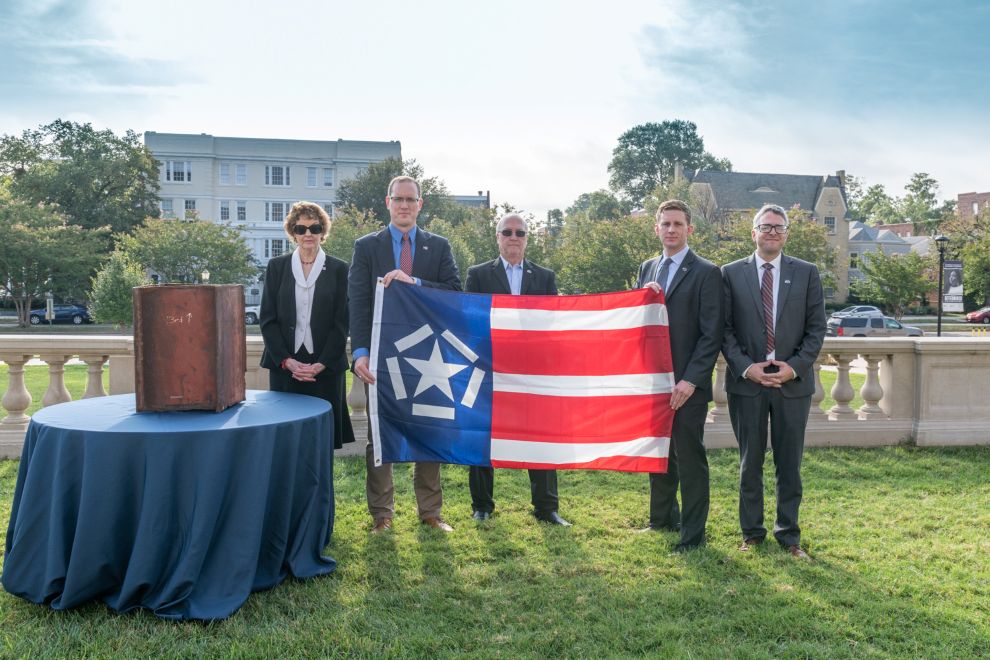
This year marks the 25th anniversary of September 11, 2001, and as always on this day, the Virginia Museum of History & Culture will fly the Freedom Flag, a tradition it has honored since the creation of the flag.
“This is a momentous occasion, a time to look back and reflect,” says Corey Piper, the Museum’s curator of collections, about the 25th anniversary.
Many people, including yours truly, remember exactly where they were to the minute when word came that two planes had collided with the Twin Towers in New York City.
Americans grieved but Richard Melito, owner of Melito’s restaurant in Henrico, did more. He pulled out a napkin and sketched out his early design of the Freedom Flag.
“In weeks following attacks he was like others struggling with coming to terms with 9/11,” says Piper. “His sketch was refined and developed as the Freedom Flag. It resonated with people.”
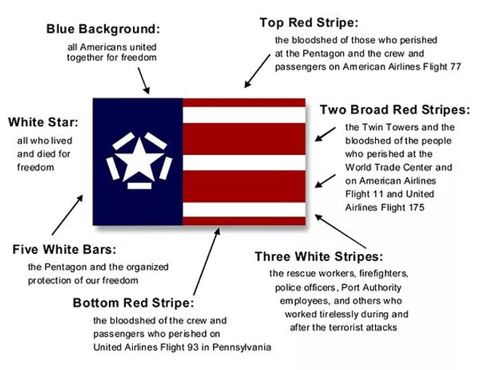
A non-profit organization, the Freedom Flag Foundation, formed during Senator Mark Warner’s term as governor to establish the Freedom Flag as a national symbol of remembrance for September 11, 2001. That became a reality on March 30th, 2018, when the Freedom Flag made Virginia history after SB754 was signed into law by Governor Ralph S. Northam, instituting the Freedom Flag as the official remembrance of 9/11 in Virginia. Warner had previously recognized the flag as the state’s official symbol of remembrance through an executive order in 2003.
As a way to remember and pay tribute to 9/11, the Virginia Museum of History and Culture is committed to sharing its collection and stories in association with that fateful day.
While the museum isn’t mounting a specific exhibit on 9/11, within its permanent collections are hundreds of objects from that day, the most prominent being their prized Freedom Flag, the third of the first 50 produced in the first commercial run.
“The one we have in our collection is not flown,” explains Piper. “The one we fly is one we purchased. It’s important to preserve one of the first examples of the flag. It is an example of how people responded in the wake of 9/11.”
One of the most evocative artifacts from 9/11 is a piece of the Pentagon from the west side of the building where it was hit by a plane, on view in the exhibition “Story of Virginia.” Another, in the exhibition “Our Commonwealth,” is a piece of steel produced by Banker’s Steel in Virginia, part of the construction of the Freedom Tower at One Trade Center in New York, which was erected after the Trade Tower buildings were destroyed.
“These artifacts of the events of that day are part of the story of Virginia,” says Piper. “We take these artifacts very seriously because they serve as touchstones for conversations where people can share their memories. These objects and stories keep memories alive and serve that people who are not alive because of that day will always be remembered.”
The Museum’s collections also include artifacts related to the rebuilding of the Pentagon, working documents for Project Phoenix as well as personal items from Dr. Kevin McCowen from Virginia.
“He happened to be in Manhattan on that day,” Piper says. “He spent many hours at Ground Zero helping the survivors. We have his scrubs and the stethoscope he used that day. He found himself in the nucleus of a tragedy and responded with bravery.”
Having these items in the Museum’s collection, Piper adds, help ensure “that history informs and shows the way we approach the world we live in.”